
Commercial intelligence for the rail supply chain
Know what rail will buy next.
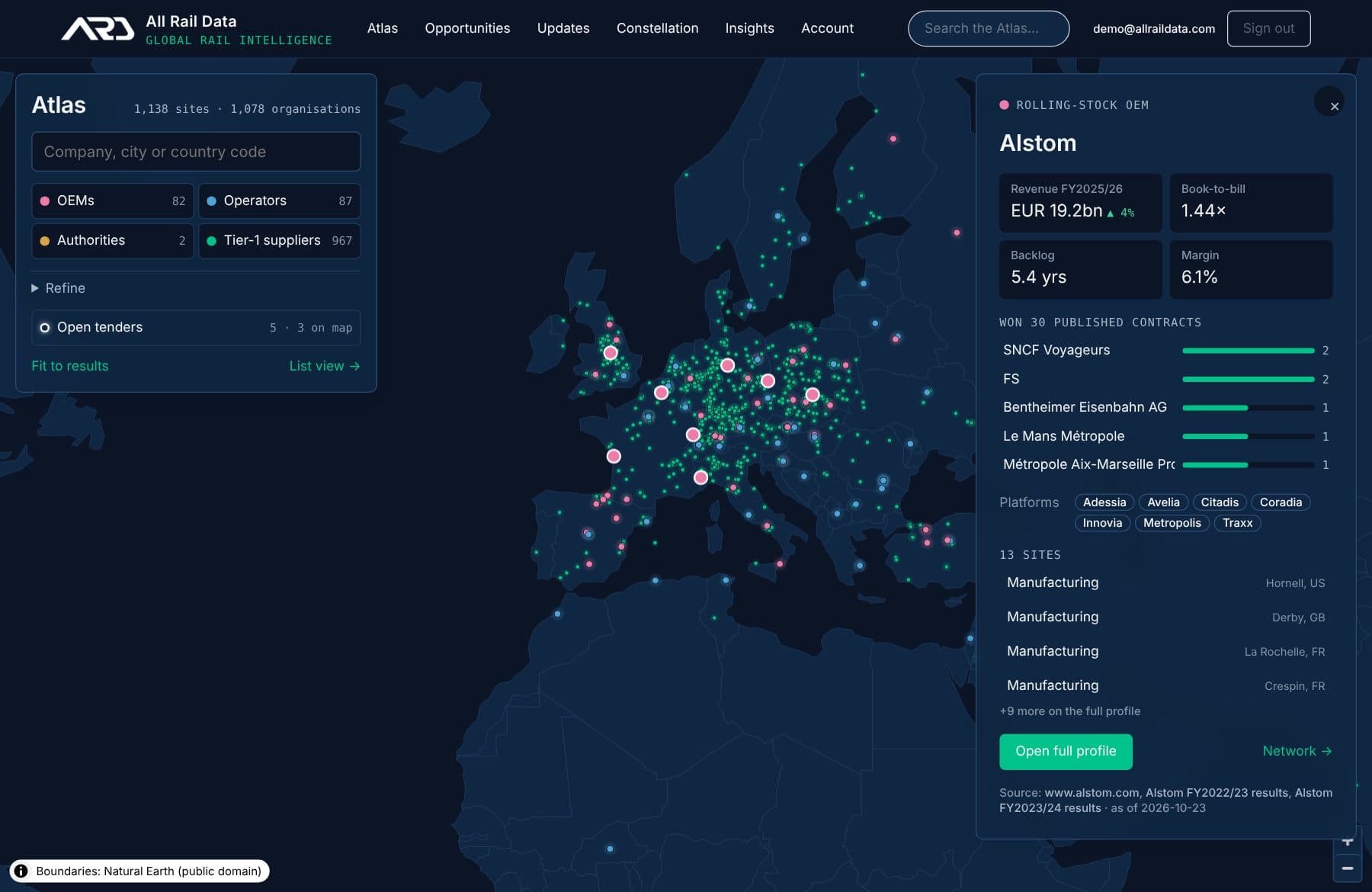
ARD maps who operates, who builds and who supplies in global rail — and where — and shows the evidence behind each fact, so you can move before a competitor does.
By invitation — the first 25 accounts. Sign in
- organisations
- 3,069
- sites, city-level
- 3,510
- countries
- 75
- facts, each with its evidence
- 13,758
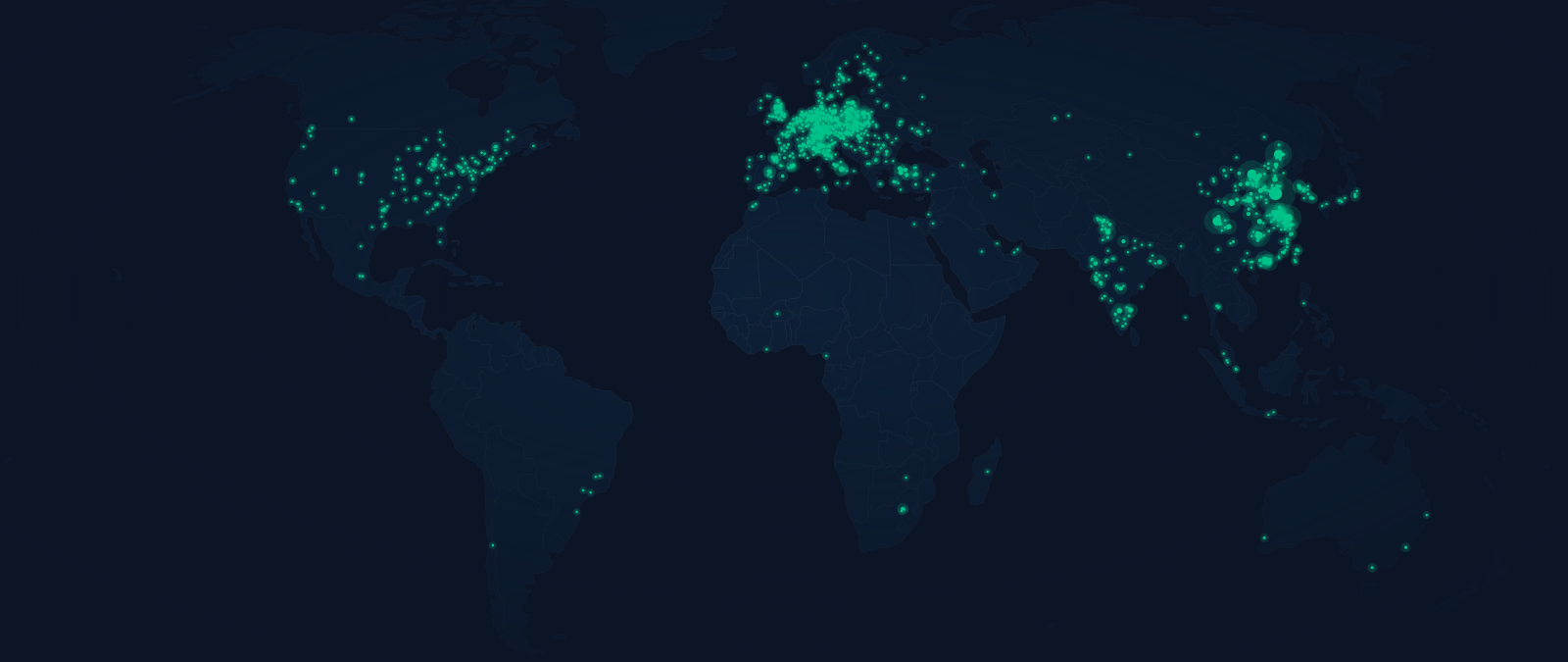
Every point is a site in the corpus — 3,510 across 75 countries.
01 — Inside the graph, right now
2,919
Tier-1 component suppliers
128
rail operators and transport authorities
90
rolling-stock platforms, across 22 OEMs
02 — Ask ARD
Stop researching. Start asking.
Instead of ten browser tabs and a stale spreadsheet, ask the graph directly — in plain language.
03 — The problem
The deal that showed up in a press release, not your pipeline.
A platform gets nominated. The Tier-1 list closes. Your first sign of it is a press release, or a call from a competitor who already has a foot in the door — not because they're smarter, but because they were watching. By the time it reaches a generic company database, the sourcing window has usually already moved on.
04 — The mechanism
From operator tender to your RFQ.
Every stage is a real, evidence-linked step. At the plant the line divides — one road to the systems, one to the components inside them.
- OperatorFor anyone selling into rail
The tender was public for days before anyone thought to tell you.
An operator opens a tender. ARD records it the day it publishes.
- TenderFor bid and capture teams
Nobody announces a shortlist. Qualification closes in silence.
Bidders are identified as qualification closes.
- AwardFor sales leadership
You read the award in a press release. Someone else read it in the minutes.
The award is recorded — winner, value, date.
- OEMFor key account managers
An award names a company. It does not name a programme.
The winning OEM's programme and platform are matched to it.
- PlantFor regional sales
An OEM has many plants. One of them builds this one.
The likely production site is identified from OEM footprint data.
- Tier-1For business development
A platform is not a shopping list — until somebody maps it to one.
Sourcing categories are mapped to the platform's subsystems.
- Tier-2For component manufacturers
This is where most suppliers stop looking. It is where their market is.
The line divides. Component-level opportunities surface inside each subsystem.
- Your RFQFor the desk the RFQ lands on
By the time an RFQ arrives, the decisions inside it are already made.
You see the estimated sourcing window — before it reaches your inbox.
05 — From the trials
What the prototype showed the people who used it.
“We stopped finding out about sourcing windows from our own suppliers. ARD had the plant and the platform mapped before our own regional team did.”
Global Purchasing Director, French rolling-stock OEM “Most databases give us a company name and nothing to act on. This gave us the site, the subsystem, and which account to call first.”
Head of Business Development, Spanish Tier-1 supplier “The evidence trail is what convinced our team — every claim had a source and a date, so nobody had to double-check it before a client call.”
Commercial Director, German Tier-2 component manufacturer
06 — The product
Know who is buying, and when to be in the room.
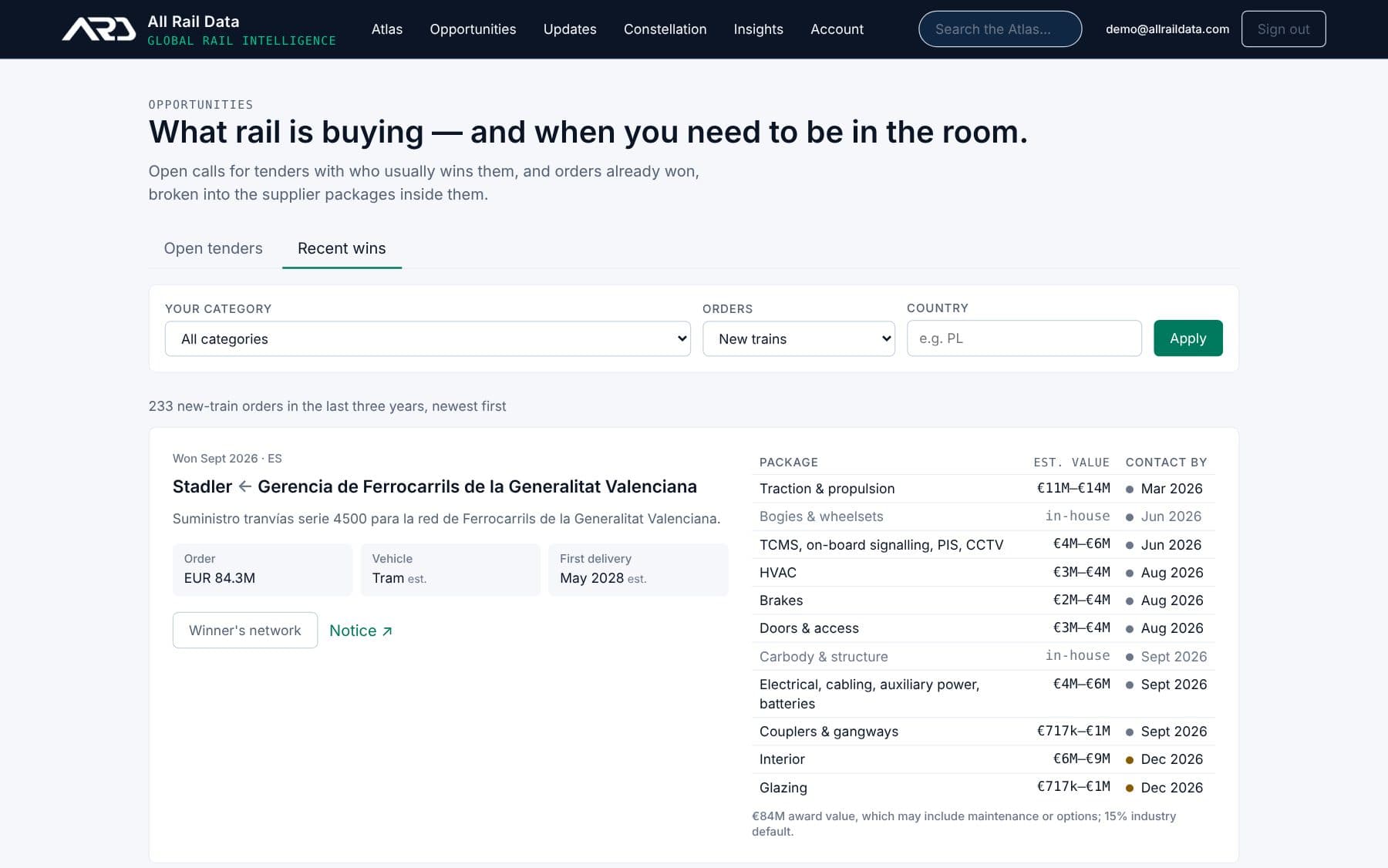
Every new-train order is broken into the supplier packages inside it, with a value range and the date the OEM is likely to start sourcing each one. Every figure and site carries its source, so the answer you take into a customer meeting is one you can cite.
07 — Founding Access
The first 25 accounts, by invitation.
ARD is in an invite-only founding phase — the corpus is growing fast enough that access is deliberately limited while that's true. Founding accounts get a direct line to what gets built next.